What Are the Optimal Conditions for Denitrification?

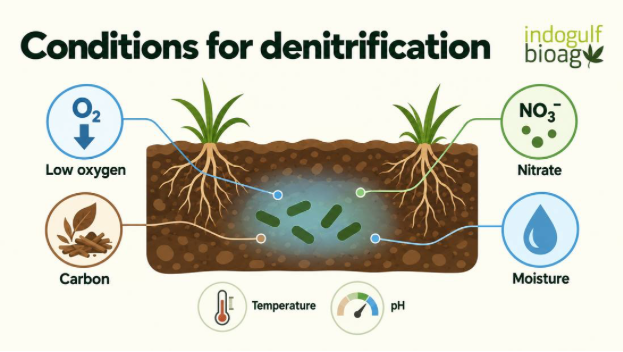
There is no single "ideal" setting for denitrification across soil, wetlands, and wastewater treatment. The process needs active nitrate-reducing microorganisms, an available source of nitrate, a usable electron donor, and conditions in which oxygen is limited. How much of that nitrogen reaches harmless nitrogen gas rather than escaping as nitrous oxide depends on the environment as well [1] [2].
This guide works through each condition in turn, and closes with the two questions that matter most in practice: is denitrification actually happening here, and is it finishing the job.
Optimal conditions for denitrification -low oxygen
Many denitrifying microorganisms use oxygen when it is readily available and switch to nitrate as an electron acceptor once oxygen becomes scarce. Poorly aerated sediments, saturated soil microsites, and the interiors of biofilms all provide these oxygen-poor zones [1]. Oxygen conditions can vary over millimeters, so a soil surface can be well aerated while a nearby aggregate, just below it, supports active denitrification [1].
This spatial patchiness is part of why denitrification is so hard to predict from bulk soil measurements alone: two soil cores taken a few centimeters apart can behave very differently.
Available Nitrate — and Its Limits
Nitrate is the starting material for the conventional denitrification pathway. If little nitrate is available, the overall removal rate is limited regardless of how favorable the other conditions are. If a large amount of nitrate coincides with wet, oxygen-poor soil, greater nitrogen loss becomes possible [1] [3].
Adding more fertilizer simply to drive denitrification is never a sound crop-management strategy — it increases the very loss pathway a nutrient program is trying to avoid. Nor is all the nitrate that disappears necessarily denitrified: it can also be consumed by dissimilatory nitrate reduction to ammonium (DNRA), which retains rather than removes the nitrogen. Globally, DNRA has been estimated to account for roughly 21% of total nitrate reduction across ecosystems, and it has been found to dominate over denitrification entirely in some fertilized farmland soils [4] [5].
An Electron Donor and Active Microbes
Many denitrifiers use organic carbon to supply the electrons needed to reduce nitrate; carbon quality and accessibility matter as much as total carbon quantity. Roots, crop residues, or sediment organic matter can supply that carbon in soils, while engineered treatment systems may rely on a deliberately controlled carbon source. Some specialized denitrifiers use inorganic electron donors instead of organic carbon. Microbial community composition affects which reactions in the pathway can actually be completed [1].
Denitrifying woodchip bioreactors, increasingly used to treat agricultural drainage water, illustrate the electron-donor constraint directly: the woodchips themselves supply a renewable carbon source, but the recalcitrance of lignocellulosic wood carbon means many bioreactors are carbon-limited in practice. Research using oxic-anoxic cycling — brief oxygen exposure followed by anoxic periods — found that transient oxic periods stimulated fungal ligninolytic enzymes that made woodchip-derived carbon more available, increased nitrate removal rates, and shifted the nitrous oxide reductase gene population in ways that were strongly correlated with lower nitrous oxide output [6]. In other words, the carbon supply and the outcome at the final enzymatic step are connected, not independent variables.
Moisture and Temperature
Water slows the diffusion of oxygen into soil, which is exactly what creates the microsites where denitrification occurs. As a result, activity often rises when soil becomes wet, especially once nitrate is also available [1]. That does not make saturated farmland desirable: persistent waterlogging can impair roots and waste plant-available nitrogen at the same time [1] [3].
Microbial reaction rates generally speed up as temperatures rise within an organism's working range, and slow under cold conditions. Temperature also interacts with moisture and nitrate availability, so no single "best" temperature figure would be accurate across sites and seasons [1] [3].
pH and Completion of the Last Step
Soil pH influences both the microorganisms present and the enzymes they express. Acidic conditions can interfere specifically with the final conversion of nitrous oxide to nitrogen gas, raising the share of nitrogen that leaves as nitrous oxide rather than the inert end product — a pattern demonstrated both in laboratory strains and in whole soils and soil-extracted microbial communities [7]. Near-neutral conditions often support fuller conversion, but the outcome still depends on the specific soil, microbial community, and oxygen pattern present; there is no universal target pH that applies to every site [1] [7].
The pH relationship has a documented exception worth knowing: at least one aquifer study found a community enriched in a particular nitrous oxide reductase gene variant (clade II) actively reducing nitrous oxide at a pH of 4, below the pH of roughly 5 generally treated as the practical cutoff for that reaction [8]. The general pH relationship holds; which specific organisms are present can shift exactly where the boundary sits.
When Conditions Favor a Competing Pathway Instead
Denitrification is not the only microbial process competing for available nitrate once oxygen becomes limiting. Anaerobic ammonium oxidation (anammox) offers another route to nitrogen gas, and DNRA reduces nitrate to ammonium instead of removing it from the system. A global synthesis of more than 1,500 observations found the balance among these three pathways shifts with soil organic carbon, ammonium, nitrate, and ferrous iron concentrations — meaning the same conditions that look "optimal" for denitrification on paper can, in a different soil, favor a different pathway with a very different outcome for nitrogen retention [4].
A Practical Way to Read the Conditions
For a water-treatment system, track influent nitrogen concentration, the oxygen profile through the system, carbon availability, pH, and nitrogen species in the effluent, along with gaseous emissions where that is feasible to measure. For fields, assess drainage, recent rainfall, soil temperature, and the timing of nitrate availability relative to crop uptake [1] [2] [3].
The conditions that favor nitrate removal in a constructed wetland are not necessarily the conditions that protect fertilizer nitrogen in a cropped field — in fact, they are often close to the opposite of what a grower wants.
What the Evidence Does Not Support
That any single factor — oxygen, nitrate, carbon, moisture, temperature, or pH — determines the outcome on its own; all interact [1]
That a universal "best" temperature or "target" pH applies across soils, wetlands, and treatment systems [1] [7]
That acidic conditions always suppress the final reduction step in every microbial community; documented exceptions exist where specific enzyme variants sustain activity at low pH [8]
That applying more nitrate fertilizer to "feed" denitrification is ever a defensible crop-management decision
That nitrate loss under favorable-looking conditions is necessarily denitrification rather than a competing pathway such as DNRA or anammox [4] [5]
Best Conditions Summarized
Genuinely low-oxygen microsites, which can exist even within an otherwise aerated soil profile
Nitrate present, but not applied in excess of what a system's electron-donor supply and hydrology can process
An accessible carbon source or, in specialized systems, an appropriate inorganic electron donor
Adequate but not persistent moisture, avoiding prolonged waterlogging in cropland
Temperatures within the microbial community's active range
Near-neutral pH where complete conversion to nitrogen gas, rather than nitrous oxide, is the goal
A microbial community actually capable of completing all four enzymatic steps, not merely one that can start the pathway
Practical Tips for Managing the Conditions You Control
Improve field drainage to shorten the duration of oxygen-poor microsites, rather than trying to eliminate them entirely, which is not realistic in most soils
Match nitrate availability to crop demand through split applications or timing adjustments, so less nitrate sits idle during high-risk saturated periods
Monitor and manage soil pH, since acidic, poorly drained fields are the combination most associated with incomplete conversion and higher nitrous oxide loss [7]
In engineered nitrate-removal systems such as woodchip bioreactors, consider whether an oxic-anoxic operating cycle could improve carbon availability and reduce nitrous oxide output, based on the mechanism demonstrated in bioreactor research [6]
Do not assume a wet, nitrate-rich field is "safely" denitrifying; verify with soil or drainage water testing rather than assuming the favorable-looking conditions guarantee the outcome you want
Record which conditions coincided with the largest apparent nitrogen losses on your own fields each season, since the interacting factors here are genuinely site-specific
FAQs
What are the basic requirements for denitrification to occur?
Active nitrate-reducing microorganisms, an available source of nitrate, a usable electron donor (commonly organic carbon), and oxygen-limited conditions [1].
Does more nitrate always mean more denitrification?
Only up to a point, and only where the other conditions — oxygen, carbon, moisture — are also favorable. Nitrate can also be consumed by competing pathways such as DNRA rather than being denitrified at all [4].
What limits denitrification in a woodchip bioreactor?
Carbon availability is often the limiting factor, because the lignocellulosic carbon in woodchips is not readily accessible. Research shows that periodic oxygen exposure can help unlock that carbon and has been linked to lower nitrous oxide output [6].
Can denitrification happen even in a well-drained field?
Yes, in localized microsites. Oxygen conditions vary over millimeters, so pockets of active denitrification can exist within soil that looks well aerated overall [1].
Is temperature the main driver of denitrification rate?
It is one driver among several. Reaction rates generally rise with temperature within an organism's working range, but temperature interacts with moisture and nitrate availability, so it cannot be assessed in isolation [1].
How do I know if the conditions on my field are actually favoring nitrogen loss?
Track drainage, rainfall, soil temperature, and the timing of nitrate availability relative to crop uptake, and consider soil or tile-drainage testing rather than relying on visual assessment of waterlogging alone [2] [3].
Denitrification is strongest where suitable microorganisms find nitrate and an electron donor under low-oxygen conditions. Effective management asks two further questions beyond that: whether the pathway actually finishes at nitrogen gas rather than stalling at nitrous oxide, and whether nitrogen removal is even desirable at that particular location.
Published evidence on the conditions favoring denitrification describes general environmental and microbial drivers; the specific outcome on any given site depends on its soil, hydrology, and microbial community, and should be assessed for that site rather than assumed from the general pattern.
Build Stronger Biological Programs with IndoGulf BioAg
Getting more of your applied nitrogen into the crop, rather than lost to denitrification and its competing pathways, starts with understanding the conditions that drive those losses on your own ground.
IndoGulf BioAg develops and supplies non-GMO nitrogen-fixing bacterial cultures and biofertilizer formulations designed to supply nitrogen through biological processes as part of an integrated nutrient-management program, for agriculture, horticulture, seed treatment, and private-label applications. Strain identity, viable-cell concentration, formulation options, and quality-control specifications are available on request. Contact our team to discuss a nitrogen strategy suited to your soils and cropping system.
References
1. Giles M, Morley N, Baggs EM, Daniell TJ. Soil nitrate reducing processes — drivers, mechanisms for spatial variation, and significance for nitrous oxide production. Frontiers in Microbiology, 2012;3:407. DOI: 10.3389/fmicb.2012.00407 — free full text
2. U.S. Geological Survey. Nutrients in the Nation's Streams and Groundwater: Frequently Asked Questions, denitrification section. water.usgs.gov
3. University of Minnesota Extension. Saturated Soil and Nitrogen Loss: How Much Rainfall Is Too Much? 2023. extension.umn.edu
4. Deng D, He G, Ding B, Liu W, Yang Z, Ma L. Denitrification dominates dissimilatory nitrate reduction across global natural ecosystems. Global Change Biology, 2024;30(3):e17256. DOI: 10.1111/gcb.17256
5. Pan H, Qin Y, Wang Y, Liu S, Yu B, Song Y, Wang X, Zhu G. Dissimilatory nitrate/nitrite reduction to ammonium (DNRA) pathway dominates nitrate reduction processes in rhizosphere and non-rhizosphere of four fertilized farmland soil. Environmental Research, 2020;186:109612. DOI: 10.1016/j.envres.2020.109612
6. McGuire PM, Butkevich N, Saksena AV, Walter MT, Shapleigh JP, Reid MC. Oxic-anoxic cycling promotes coupling between complex carbon metabolism and denitrification in woodchip bioreactors. Environmental Microbiology, 2023;25(9):1696-1712. DOI: 10.1111/1462-2920.16387
7. Bakken LR, Bergaust L, Liu B, Frostegård Å. Regulation of denitrification at the cellular level: a clue to the understanding of N₂O emissions from soils. Philosophical Transactions of the Royal Society B, 2012;367(1593):1226-1234. DOI: 10.1098/rstb.2011.0321 — free full text
8. Hunt KA, Carr AV, Otwell AE, et al. Contribution of microorganisms with the clade II nitrous oxide reductase to suppression of surface emissions of nitrous oxide. Environmental Science & Technology, 2024;58(16):7056-7065. DOI: 10.1021/acs.est.3c07972
Peer-reviewed sources were located via PubMed and publisher records; free full-text links point to PubMed Central where an open-access version is available. Institutional source URLs (USGS, University of Minnesota Extension) were provided in the original project brief; live links should be spot-checked before publication per house citation rule §4.


Comments