What Is the Role of Denitrification in the Nitrogen Cycle?


The nitrogen cycle moves nitrogen between the atmosphere, living organisms, soil, and water. Denitrification completes an important leg of that journey: microbes turn nitrate into gases, usually ending with nitrogen gas (N₂), which returns to the atmosphere it originally came from. Without a return pathway, reactive nitrogen would simply accumulate in soils and water indefinitely [1] [2].
This guide traces nitrogen's path to the point where denitrification intervenes, explains why that intervention matters differently in a wetland than in a cornfield, and states clearly where the science stops.
Where Nitrate Comes From
Plants need accessible nitrogen to grow, and very little of it arrives ready-made. Soil organic matter and applied fertilizers most often supply ammonium, while nitrifying microorganisms — ammonia-oxidizing bacteria and archaea, followed by nitrite-oxidizing bacteria — convert that ammonium to nitrite and then nitrate wherever oxygen is present [1]. Nitrate is soluble and readily taken up by roots, but that same solubility means it can just as easily move into drainage water or groundwater before a plant gets to it.
Nitrate, in other words, sits at a fork in the road: uptake by a plant, loss to water, or reduction back to gas by denitrifying and other nitrate-reducing microorganisms.
How Denitrification Closes the Loop
Denitrification in the Nitrogen Cycle
When oxygen is limited, some soil and aquatic microorganisms use nitrate instead of oxygen as a respiratory electron acceptor. Through a series of enzyme-driven reactions, they convert nitrate to nitrogen gas, which diffuses out of the soil or water and returns to the atmosphere [1]. This removes nitrate from the local system and completes the return leg of the cycle: nitrogen fixation and other biological and industrial processes later bring atmospheric nitrogen back into biologically available forms, and the cycle continues.
Without denitrification and its associated processes, essentially all of the roughly 78% of the atmosphere that is nitrogen gas would eventually be drawn down into reactive forms and stay there, with no natural route back.
Denitrification in the Global Nitrogen Budget
The scale of the modern nitrogen cycle is worth stating plainly, because it shows why the return pathway matters so much now. Global biological nitrogen fixation contributes an estimated 413 teragrams of reactive nitrogen to terrestrial and marine ecosystems annually — and anthropogenic activity, mainly synthetic fertilizer manufacture, is responsible for roughly half of that total, adding about 210 teragrams of reactive nitrogen a year that natural cycling did not previously have to process [3]. Leaching and river transport carry an estimated 40 to 70 teragrams of nitrogen to coastal waters and the open ocean each year, on top of atmospheric deposition [3].
Denitrification, largely in soils, sediments, and the ocean, is one of the principal processes returning that reactive nitrogen to the atmospheric nitrogen-gas pool it came from. The same review notes that some marine reactive nitrogen is buried in sediment, while the remainder is denitrified back to the atmosphere as nitrogen gas or nitrous oxide [3] — underscoring that denitrification's output is not uniformly the inert gas that makes up most of the air; a fraction escapes as the greenhouse gas nitrous oxide, covered in full in our companion article on the environmental impacts of denitrification.
Why Ecosystems Need This Balance
In wetlands, streams, and constructed treatment systems, denitrification can remove nitrate before it reaches waters that are vulnerable to nutrient pollution. Reducing excess nitrogen helps address the conditions that favor algal blooms and the oxygen depletion that follows them, although phosphorus inputs and other nutrient sources also need attention — nitrogen control alone does not solve eutrophication everywhere it occurs [2] [4].
This is the genuinely beneficial side of denitrification: a natural or engineered process that intercepts reactive nitrogen before it accumulates somewhere it causes harm.
On Farmland, the Balance Looks Different
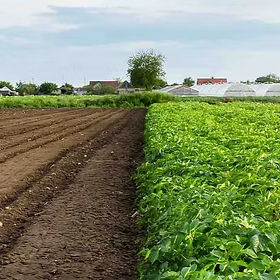
On cropland, the same reaction looks less like a service and more like a leak. If soil stays saturated after rainfall, denitrifying microbes may convert crop-available nitrate to gas before roots take it up. Denitrification remains a natural, expected part of the nitrogen cycle in this setting too — it has not gone wrong — but its timing can directly reduce the nitrogen-use efficiency of a fertilizer or nutrient-management program [5].
This is the central tension of the whole topic: the process that keeps reactive nitrogen from building up indefinitely in the environment is the same process that, on the wrong day in the wrong field, removes nitrogen a crop was counting on.
What Happens When the Process Is Incomplete
The denitrification pathway does not always run all the way to nitrogen gas. It can stop at nitrous oxide (N₂O), an intermediate that is also a potent greenhouse gas. The proportion of nitrogen that escapes as nitrous oxide rather than completing the pathway to nitrogen gas depends on oxygen availability, moisture, nitrate supply, carbon availability, soil pH, and the composition of the denitrifying community itself [1] [6]. Understanding those conditions is what separates useful nitrate removal from unwanted nitrogen loss paired with a climate cost — the subject of our companion articles on the steps of denitrification and the environmental impacts of denitrification.
Denitrification's Competitors: Other Fates for Nitrate
Denitrification is not the only microbial process that consumes nitrate once oxygen becomes limiting. Dissimilatory nitrate reduction to ammonium (DNRA) reduces nitrate back to ammonium rather than to gas, retaining the nitrogen in the soil or sediment rather than returning it to the atmosphere; anaerobic ammonium oxidation (anammox) converts ammonium and nitrite directly to nitrogen gas through a separate pathway. A global synthesis of more than 1,500 observations across terrestrial and aquatic ecosystems found denitrification responsible for up to 66.1% of total nitrate reduction, with anammox accounting for about 12.7% and DNRA about 21.2%, and found that the balance among the three shifts with soil organic carbon, ammonium, nitrate, and ferrous iron concentrations [7].
That balance is not fixed. In one study of rhizosphere and non-rhizosphere soil under four crops on arid farmland in north China, DNRA — not denitrification — dominated dissimilatory nitrate reduction, accounting for over 84% of the total [8]. The practical implication is direct: nitrate disappearing from a soil sample is not, on its own, proof that denitrification (rather than DNRA or anammox) is the process responsible, and it certainly is not proof that the nitrogen has left the field as a gas.
What the Evidence Does Not Support
That all nitrate loss from soil is denitrification; DNRA and anammox are documented competing pathways that can locally dominate nitrate reduction [7] [8]
That denitrification is simply "bad" or simply "good"; the same reaction is an environmental service in a nitrate-polluted waterway and a fertilizer-efficiency cost in a saturated field
That the nitrogen cycle is a fixed, evenly-paced loop; anthropogenic reactive nitrogen inputs are now roughly comparable in scale to natural biological nitrogen fixation, changing the load the return pathway has to process [3]
That denitrification completing means no climate impact occurred; an incomplete pathway can release nitrous oxide well before reaching the inert end product [6]
Best Conditions for Understanding Denitrification's Role On Your Land
Recognize that oxygen-poor, moist conditions — wetlands, saturated soil, biofilm interiors — are where denitrification and its competing pathways concentrate [1]
Distinguish a wetland or buffer strip deliberately positioned to intercept nitrate from a crop field where the same process is an unplanned loss
Track soil moisture and drainage after rainfall as the leading indicator of when denitrification losses are most likely to be active [5]
Treat nitrate disappearance in a soil test as a signal to investigate, not as confirmation that denitrification specifically occurred [7]
Consider soil pH as a factor in how much of any denitrified nitrogen leaves as nitrous oxide versus nitrogen gas [6]
Practical Tips for Working With the Nitrogen Cycle, Not Against It
Time nitrogen applications to match periods of active crop uptake, so less nitrate sits in the soil profile during high-risk saturated periods
Improve field drainage where practical to shorten the duration of oxygen-poor microsites that favor denitrification
Use wetlands, buffer strips, or other nitrate-interception features deliberately at field edges rather than relying on incidental in-field losses
Soil test to understand how much mineral nitrogen is present before adding more, since idle nitrate is what denitrification and its competing pathways draw on
Keep a written record of rainfall, drainage, and nitrogen timing each season, so a pattern of losses becomes visible rather than anecdotal
Do not assume that reducing tillage or improving soil health automatically reduces denitrification losses; oxygen and moisture status in the specific field still govern the outcome
FAQs
What is denitrification's basic role in the nitrogen cycle?
It is the process that returns reactive nitrogen — mainly as nitrate — to the atmosphere as nitrogen gas, closing the loop that biological and industrial nitrogen fixation opened [1].
Where does the nitrate that gets denitrified come from?
From nitrification of ammonium supplied by soil organic matter, fertilizer, or wastewater, and, in aquatic systems, from nitrate carried in by drainage or runoff [1].
How big is the modern nitrogen cycle compared to natural cycling?
Anthropogenic activity now contributes an estimated 210 teragrams of reactive nitrogen a year, comparable to the roughly 203 teragrams from natural biological nitrogen fixation implied by the 413-teragram global total, meaning human inputs have roughly doubled the amount of reactive nitrogen the cycle has to process [3].
Does all nitrate that disappears from soil get denitrified?
Why does denitrification matter for climate change, not just water quality?
Because the pathway does not always finish at inert nitrogen gas. When it stops at the intermediate nitrous oxide, a potent greenhouse gas is released instead of, or alongside, harmless nitrogen gas [6].
Can wetlands be used deliberately to support this part of the nitrogen cycle?
Yes. Wetlands, streams, and constructed treatment systems are commonly positioned to intercept nitrate and support denitrification before it reaches sensitive waters [4].
Does improving soil drainage always reduce denitrification losses?
Better drainage shortens the duration of the oxygen-poor conditions denitrification needs, which generally reduces losses, but oxygen status varies at the scale of individual soil aggregates, so results depend on the specific field and season [1] [5].
Denitrification is the return leg of the nitrogen cycle: it takes reactive nitrogen back to the atmospheric gas most of the air is already made of. That is essential at the scale of the whole planet's nitrogen budget, and it is exactly why the same reaction can be a nitrogen-management problem on a single saturated field in a single wet spring.
Published evidence on denitrification and the nitrogen cycle describes general microbial and biogeochemical mechanisms; the balance of benefit and cost on any given site depends on soil conditions, hydrology, and management, and should be assessed for that site rather than assumed from the general cycle description.
Build Stronger Biological Programs with IndoGulf BioAg
Understanding the full nitrogen cycle — fixation, mineralization, nitrification, and the denitrification losses that can follow — is what makes a nitrogen program more than a single application decision.
IndoGulf BioAg develops and supplies non-GMO nitrogen-fixing bacterial cultures and biofertilizer formulations designed to supply nitrogen through biological processes as part of an integrated nutrient-management strategy, for agriculture, horticulture, seed treatment, and private-label programs. Strain identity, viable-cell concentration, formulation options, and quality-control specifications are available on request. Contact our team to discuss how biological nitrogen inputs fit your rotation and soil conditions.
References
1. Giles M, Morley N, Baggs EM, Daniell TJ. Soil nitrate reducing processes — drivers, mechanisms for spatial variation, and significance for nitrous oxide production. Frontiers in Microbiology, 2012;3:407. DOI: 10.3389/fmicb.2012.00407 — free full text
2. U.S. Geological Survey. Nutrients in the Nation's Streams and Groundwater: Frequently Asked Questions, denitrification section. water.usgs.gov
3. Fowler D, Coyle M, Skiba U, Sutton MA, Cape JN, Reis S, Sheppard LJ, Jenkins A, Grizzetti B, Galloway JN, Vitousek P, Leach A, Bouwman AF, Butterbach-Bahl K, Dentener F, Stevenson D, Amann M, Voss M. The global nitrogen cycle in the twenty-first century. Philosophical Transactions of the Royal Society B, 2013;368(1621):20130164. DOI: 10.1098/rstb.2013.0164 — free full text
4. U.S. Environmental Protection Agency. The Effects: Dead Zones and Harmful Algal Blooms. epa.gov
5. University of Minnesota Extension. Saturated Soil and Nitrogen Loss: How Much Rainfall Is Too Much? 2023. extension.umn.edu
6. Bakken LR, Bergaust L, Liu B, Frostegård Å. Regulation of denitrification at the cellular level: a clue to the understanding of N₂O emissions from soils. Philosophical Transactions of the Royal Society B, 2012;367(1593):1226-1234. DOI: 10.1098/rstb.2011.0321 — free full text
7. Deng D, He G, Ding B, Liu W, Yang Z, Ma L. Denitrification dominates dissimilatory nitrate reduction across global natural ecosystems. Global Change Biology, 2024;30(3):e17256. DOI: 10.1111/gcb.17256
8. Pan H, Qin Y, Wang Y, Liu S, Yu B, Song Y, Wang X, Zhu G. Dissimilatory nitrate/nitrite reduction to ammonium (DNRA) pathway dominates nitrate reduction processes in rhizosphere and non-rhizosphere of four fertilized farmland soil. Environmental Research, 2020;186:109612. DOI: 10.1016/j.envres.2020.109612
Peer-reviewed sources were located via PubMed and publisher records; free full-text links point to PubMed Central where an open-access version is available. Institutional source URLs (USGS, EPA, University of Minnesota Extension) were provided in the original project brief; live links should be spot-checked before publication per house citation rule §4.


Comments