How Denitrification and Simultaneous Nitrification-Denitrification Work

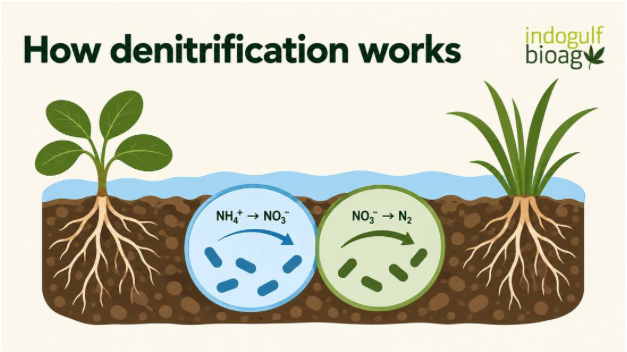
Nitrogen removal can look contradictory at first glance: nitrification needs oxygen, while denitrification works best where oxygen is scarce. Yet the two processes routinely operate within centimeters, or even micrometers, of each other. In a wastewater treatment biofilm, oxygen reaches the outer layer while the interior stays oxygen-poor. Microbes in the outer layer convert dissolved ammonium into nitrate; microbes in the interior convert that nitrate into nitrogen gas. The same layered logic plays out in soil aggregates, wetland sediments, and manure storage.
This guide explains what each process does on its own, how they link together as simultaneous nitrification and denitrification (SND), and why the practical implications differ sharply between an engineered treatment system and a farm field.
What Denitrification Does
Denitrification is a microbial process that converts nitrate (NO₃⁻) into gaseous forms of nitrogen. Its complete pathway passes through nitrite (NO₂⁻), nitric oxide (NO), and nitrous oxide (N₂O) before reaching nitrogen gas (N₂). Many bacteria use nitrate as a respiratory electron acceptor when oxygen is limited, in effect breathing nitrate instead of oxygen [1]. Nitrogen gas then leaves the water or soil and returns to the atmosphere, which is roughly 78% nitrogen gas already.
That is genuine nitrogen removal from a water treatment system. In a crop field, the same conversion removes nitrate that plant roots might otherwise have taken up. Location and purpose determine whether the loss is a benefit or a cost [2].
What Nitrification Adds
Nitrification is the oxygen-dependent conversion of ammonium (NH₄⁺) to nitrite and then nitrate, carried out by ammonia-oxidizing and nitrite-oxidizing microorganisms. It changes the chemical form of nitrogen but does not, by itself, remove nitrogen from a system. Denitrification follows by reducing that nitrate to gases. Together, the two processes can remove ammonium-derived nitrogen from wastewater in a way that neither one accomplishes alone [2].
This is worth stating plainly because the two processes are easy to conflate: nitrification is a transformation, denitrification is (usually) a removal, and only the second step actually takes reactive nitrogen out of circulation.
Why Both Can Happen Close Together
Nitrifiers need oxygen; most denitrifiers need its relative absence. The two requirements are not as incompatible as they sound, because oxygen does not distribute evenly through a biofilm, a sludge floc, a soil aggregate, or a wetland sediment. Oxygen diffuses in from the outside and is consumed as it penetrates, so concentration drops with depth. A biofilm a few hundred micrometers thick can have an oxygenated outer shell and an anoxic core within the same particle [3].
Denitrifying organisms are frequently facultative: many use oxygen when it is readily available and switch to nitrate respiration once oxygen becomes scarce, rather than being obligately anaerobic specialists [4]. That flexibility is part of what makes coupling the two processes physically possible within a single particle or a single soil microsite.
How Simultaneous Nitrification and Denitrification Works
In simultaneous nitrification and denitrification, often shortened to SND, "simultaneous" describes what is happening across one treatment unit at one point in time — not that every reaction occurs at the same oxygen level, or that a single microorganism performs every step. Oxygenated zones of a biofilm or granule support nitrification; oxygen-poor pockets deeper in the same structure support denitrification. Nitrate produced in the oxic zone diffuses into the anoxic zone, where it becomes the electron acceptor for denitrifiers [3].
A functioning SND system needs several things at once: ammonium for the nitrifiers, enough oxygen where ammonium is being oxidized, low-oxygen zones where nitrate can be reduced, and an electron donor to drive that reduction. Many denitrifiers use readily available organic carbon, though other microbial electron-donor pathways exist [3] [4]. Temperature, pH, floc or biofilm structure, and hydraulic contact time all affect how completely the coupled reactions run. Too much oxygen suppresses denitrification; too little limits nitrification — the operating window sits between the two failure modes.
The Microorganisms and Enzymes Behind Each Step
Denitrification is not a single reaction but four sequential reductions, each catalyzed by a distinct metalloenzyme: nitrate reductase, nitrite reductase, nitric oxide reductase, and nitrous oxide reductase, reducing nitrate stepwise to nitrite, nitric oxide, nitrous oxide, and finally nitrogen gas [1]. Not every denitrifying organism carries the complete enzyme set, and the final enzyme, nitrous oxide reductase, is the one most sensitive to disruption — a point that matters for how much nitrous oxide escapes before the pathway finishes (covered in detail in our companion article on the steps of denitrification). Recent work on that final enzyme has identified distinct functional variants across denitrifying organisms, some of which specialize in consuming nitrous oxide produced by other microbes without generating any of their own — a distinction with direct relevance to mitigation strategies [6].
Nitrification is carried out by a different community entirely: ammonia-oxidizing bacteria and archaea handle the first step, and a separate group of nitrite-oxidizing bacteria completes the conversion to nitrate. In an SND system, these nitrifying organisms and the denitrifying organisms downstream are not competing for the same job; they are running a relay, physically separated by an oxygen gradient inside the same floc or biofilm [3].
Where This Matters: Engineered Wastewater Treatment
Treatment operators deliberately design for SND in moving-bed biofilm reactors and aerobic granular sludge systems, because bringing both reactions into one biological treatment stage can simplify plant design and reduce the separate aeration and anoxic tankage that conventional nitrogen removal would otherwise require [3]. The design goal is a specific, monitored balance of dissolved oxygen, ammonium loading, carbon dosing, and contact time.
That does not make SND a "set and forget" process. Removal efficiency and nitrous oxide emissions still have to be measured, because incomplete denitrification inside the same granules that make SND possible is also what allows nitrous oxide, an intermediate in the pathway, to escape before the final reduction step runs to completion [3]. Nitrous oxide production from soils and engineered systems alike remains an active research area precisely because the underlying microbial and physical controls are still being worked out in detail, not a fully solved measurement problem [5].
Where This Matters: Soil and Natural Systems
Similar oxygen gradients develop naturally in soil aggregates and wetland sediments — a saturated micro-zone a few millimeters from an aerated pore can support denitrification even while the surrounding soil is well oxygenated [4]. Observing both nitrification and denitrification activity in the same field does not mean that field behaves like an engineered SND reactor. A wastewater system is deliberately built, dosed, and monitored to hold a target balance; a soil aggregate's oxygen status shifts with rainfall, drainage, temperature, and biological oxygen demand, largely outside anyone's control.
For farms and natural systems, the practical question is different from the one an operator asks: not "how do we optimize this coupling," but "when is nitrogen being retained where roots can reach it, and when is a waterlogged, oxygen-poor pocket quietly converting nitrate to gas?"
Genuine Removal Versus Relocation: Reading the Outcome Correctly
Whether SND, or denitrification alone, represents a benefit or a cost depends entirely on where the nitrogen was headed before the reaction intervened. In a treatment plant, ammonium in wastewater is a pollutant; converting it to nitrogen gas is the intended outcome, and effluent nitrogen concentrations fall. In a crop field, ammonium and nitrate are usually plant-available nutrients; converting that same nitrate to nitrogen gas is nitrogen the crop needed, lost to the air before roots could take it up [2].
The chemistry does not change between these two settings. The verdict on whether it helped or hurt depends on what the nitrogen was for.
What the Evidence Does Not Support
That "simultaneous" means every microorganism in the system performs every step of both processes — it describes zones within a shared structure, not a single universal organism [3]
That observing nitrification and denitrification together in a soil sample means that soil is behaving like a designed, monitored SND reactor
That coupling nitrification and denitrification automatically eliminates nitrous oxide emissions; incomplete reduction inside the same biofilm that enables SND is also a documented route by which nitrous oxide escapes [3]
That denitrification is inherently good or bad; its value depends entirely on whether the nitrogen it removes was a pollutant or a nutrient in that specific location
Best Conditions for Coupled Nitrification and Denitrification
A structure — biofilm, floc, granule, or soil aggregate — thick enough to sustain an oxygen gradient from oxic exterior to anoxic interior
Adequate ammonium supply and dissolved oxygen where nitrification needs to occur
A genuinely low-oxygen zone nearby, so nitrate produced by nitrifiers has somewhere to be reduced
An available electron donor, most often organic carbon, to drive the reduction steps
Temperature, pH, and contact time within the range that supports both microbial communities
In engineered systems, active monitoring of dissolved oxygen and nitrogen species rather than a one-time design assumption
Practical Tips for Reading Nitrogen Behavior on Your Own Ground
Do not assume a waterlogged field patch is performing a controlled, beneficial nitrogen removal service; assess whether the nitrogen lost there was still needed by the crop
Where drainage is poor after rainfall, expect denitrification losses to rise, independent of any nitrification happening nearby
In constructed wetlands or treatment systems designed for SND, monitor effluent nitrogen species and, where feasible, nitrous oxide emissions rather than assuming the reactor is running to completion
Match nitrogen applications to crop uptake timing so less nitrate is available to denitrify during saturated periods
Keep drainage functioning well enough to limit the extent and duration of anoxic microsites in the root zone
Treat "the field removed some nitrogen" and "the field lost nitrogen the crop needed" as two different findings that both need checking
FAQs
Is denitrification the same thing as simultaneous nitrification and denitrification?
No. Denitrification is one process: converting nitrate to nitrogen gases. SND describes a system where nitrification and denitrification occur together, in different microzones of the same structure, so that ammonium can be converted all the way to nitrogen gas in one setting [3].
How can an aerobic process and an anaerobic process happen in the same biofilm?
Does SND remove more nitrogen than denitrification alone?
SND removes ammonium-derived nitrogen that denitrification alone could not touch, because denitrification needs nitrate as a starting material and ammonium first has to be nitrified to produce it. The combination, not either step alone, is what completes ammonium removal [2].
Can a farm field behave like an SND wastewater reactor?
Similar oxygen gradients occur in soil aggregates and wetland sediments, but a field is not deliberately designed, dosed, or monitored the way a treatment reactor is. Observing both processes in soil does not establish reactor-like, optimized performance [4].
Does SND always produce nitrogen gas, or can it release nitrous oxide?
It can do either. Nitrous oxide is an intermediate in the denitrification pathway, and incomplete reduction — which can occur inside the same biofilms that enable SND — allows some to escape before the final step to nitrogen gas [3].
Why do some bacteria switch between using oxygen and using nitrate?
Many denitrifiers are facultative: they prefer oxygen as an electron acceptor when it is available because it is energetically favorable, and switch to nitrate respiration once oxygen becomes limiting. This flexibility is part of what allows the same organism to persist across changing oxygen conditions [4].
Is nitrogen lost through SND or denitrification a fertilizer efficiency problem?
In a cropped field, yes — nitrate converted to nitrogen gas is nitrogen the crop cannot use, which is why the same conversion that is desirable in a treatment plant is undesirable in a fertilized field with saturated soil [2].
Do all denitrifying bacteria carry the same set of enzymes?
No. Not every denitrifier has the complete four-enzyme pathway, and which enzymes a given organism or community expresses affects whether the process stops at an intermediate like nitrous oxide or runs through to nitrogen gas [1].
Denitrification and nitrification are opposite reactions that nonetheless depend on each other in many real systems. Understanding where the oxygen gradient sits — inside a treatment granule or across a few millimeters of soil — is what separates a controlled nitrogen-removal process from an uncontrolled nitrogen loss.
Published evidence on denitrification and simultaneous nitrification-denitrification describes general microbial mechanisms; the balance between nitrogen retained and nitrogen lost on any given site depends on soil or system conditions, management, and monitoring, and should be assessed for that specific site rather than assumed from the general process description.
Build Stronger Biological Programs with IndoGulf BioAg
Understanding how nitrogen moves — and where it can be lost — is the starting point for a nutrition program that gets more of the nitrogen you apply into the crop rather than into the air.
IndoGulf BioAg develops and supplies non-GMO nitrogen-fixing bacterial cultures and biofertilizer formulations designed to supply nitrogen through biological processes as part of an integrated nutrient-management program, for agriculture, horticulture, seed treatment, and private-label applications. Strain identity, viable-cell concentration, formulation options, and quality-control specifications are available on request. Contact our team to discuss a nitrogen strategy suited to your soils and cropping system.

References
1. Tavares P, Pereira AS, Moura JJG, Moura I. Metalloenzymes of the denitrification pathway. Journal of Inorganic Biochemistry, 2006;100(12):2087-2100. DOI: 10.1016/j.jinorgbio.2006.09.003
2. U.S. Geological Survey. Nutrients in the Nation's Streams and Groundwater: Frequently Asked Questions, denitrification section. water.usgs.gov
3. Di Capua F, Iannacone F, Sabba F, Esposito G. Simultaneous nitrification-denitrification in biofilm systems for wastewater treatment: key factors, potential routes, and engineered applications. Bioresource Technology, 2022;361:127702. DOI: 10.1016/j.biortech.2022.127702
4. Giles M, Morley N, Baggs EM, Daniell TJ. Soil nitrate reducing processes — drivers, mechanisms for spatial variation, and significance for nitrous oxide production. Frontiers in Microbiology, 2012;3:407. DOI: 10.3389/fmicb.2012.00407 — free full text
5. Butterbach-Bahl K, Baggs EM, Dannenmann M, Kiese R, Zechmeister-Boltenstern S. Nitrous oxide emissions from soils: how well do we understand the processes and their controls? Philosophical Transactions of the Royal Society B, 2013;368(1621):20130122. DOI: 10.1098/rstb.2013.0122 — free full text
6. Moir JWB, Toet S, Keane B. Nitrous oxide flux: what microbial physiology can do to mitigate climate change gas production. Advances in Microbial Physiology, 2025;87:119-161. DOI: 10.1016/bs.ampbs.2025.04.001
Peer-reviewed sources were located via PubMed and publisher records; free full-text links point to PubMed Central where an open-access version is available. Institutional source URLs (USGS) were provided in the original project brief; live links should be spot-checked before publication per house citation rule §4.


Comments