What Are the Environmental Impacts of Denitrification?


Denitrification has two very different environmental roles. It removes excess nitrate from water by converting it to nitrogen gas, which is a genuine water-quality benefit. Yet the same reaction can remove valuable, plant-available nitrogen from farmland. And if the microbial pathway stops short of nitrogen gas, it can release nitrous oxide, a powerful greenhouse gas, instead. Understanding where denitrification occurs, and how completely it runs, is the key to judging its impact in any specific case [1] [2] [3] [4].
This guide covers the benefit, the cost, the climate dimension, and the management practices with real evidence behind them — rather than treating denitrification as simply good or simply bad.
The Benefit: Nitrate Removal From Water
Environmental Impacts of Denitrification
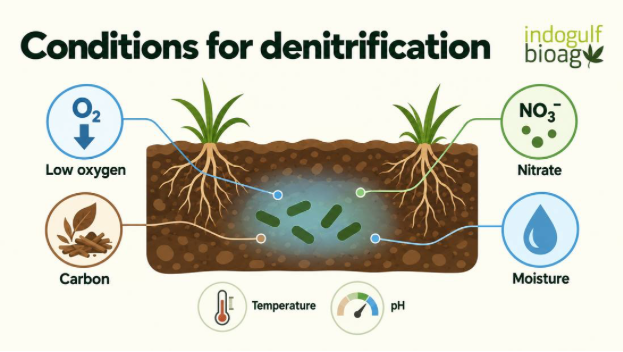
In oxygen-poor sediments, wetlands, and carefully designed treatment systems, microorganisms can convert dissolved nitrate into nitrogen gas. This lowers the amount of reactive nitrogen moving downstream or through groundwater [1]. The U.S. Geological Survey identifies low dissolved oxygen and organic-rich sediments as the conditions that favor this kind of nitrate removal [1].
Less nitrogen reaching a waterbody can help limit nutrient-driven algal growth and the oxygen depletion that follows it. Nitrogen is only part of that story, though: phosphorus inputs, water flow, and other conditions also shape eutrophication, so denitrification works best as one measure among several that prevent excess nutrients from reaching waterways in the first place, not as a stand-alone fix [2].

The Cost: Nitrogen Loss From Farmland
The identical chemical conversion is undesirable in a cropped field. After prolonged rainfall or poor drainage, soil oxygen becomes limited and nitrate fertilizer may be converted to gas and lost before roots ever reach it [3]. Denitrification is distinct from nitrate leaching — one sends nitrogen into the air as gas, the other carries dissolved nitrate away with moving water — and both can occur in the same wet field conditions, sometimes simultaneously [3].
For a nutrient-management program, this cost is largely invisible until yield or tissue testing reveals a shortfall, because the nitrogen simply disappears into the air rather than showing up as a visible symptom of an application error.
The Climate Concern: Nitrous Oxide
Nitrous oxide (N₂O) is an intermediate in the denitrification pathway, produced at the third of four enzymatic steps. Some of it is reduced further to nitrogen gas by a fourth enzyme, nitrous oxide reductase, but some can escape before that final step runs, particularly when soil conditions or the microbial community present limit that last reaction [5]. Soil acidity in particular has been linked, in laboratory strains and in whole soils and soil-extracted communities alike, to interference with how that final enzyme assembles, which raises the share of nitrogen released as N₂O rather than N₂ [6]. Nitrous oxide can also arise from other nitrogen transformations besides denitrification, so a measured N₂O emission cannot automatically be assigned to denitrification alone [4].
According to the U.S. Environmental Protection Agency, a given mass of nitrous oxide has 273 times the 100-year global warming potential of the same mass of carbon dioxide [7]. That figure explains why a process that removes nitrate from a system can still carry a real climate cost if a meaningful share of that nitrogen escapes as N₂O rather than completing the pathway to inert nitrogen gas.
How Large Is the Nitrogen Problem Denitrification Is Responding To?
The scale of reactive nitrogen in the environment gives useful context for why denitrification's role matters as much as it does. Global biological nitrogen fixation now adds an estimated 413 teragrams of reactive nitrogen to terrestrial and marine ecosystems each year, and human activity — chiefly synthetic fertilizer manufacture — accounts for roughly half of that, about 210 teragrams a year that natural cycling did not previously have to process [8]. An estimated 40 to 70 teragrams of nitrogen reach coastal waters and the open ocean annually through leaching and river transport alone [8].
Denitrification, together with competing pathways like anammox and burial in sediment, is one of the main routes by which that reactive nitrogen eventually returns to the atmosphere [8]. Given the scale of the anthropogenic addition, both the water-quality benefit and the nitrous oxide risk of denitrification are larger and more consequential now than they were before large-scale synthetic fertilizer use began.
Engineered Denitrification: Bioreactors and Constructed Wetlands
Denitrifying woodchip bioreactors are an increasingly common way to intercept nitrate in agricultural drainage water before it reaches a stream, using woodchips as a renewable carbon source to fuel microbial denitrification [9]. Because the carbon in wood is not easily accessible, many of these systems are carbon-limited, which affects both how much nitrate they remove and how much nitrous oxide they emit while doing it. Research using deliberate oxic-anoxic cycling found that brief oxygen exposure could mobilize more of that woodchip carbon, increase nitrate removal, and shift the resident nitrous oxide reductase gene population toward types associated with lower nitrous oxide output [9].
This is a useful illustration for any engineered or constructed nitrate-removal feature: nitrate removal and nitrous oxide production are not automatically linked in one direction. A well-designed and monitored system can achieve strong nitrate removal with comparatively low nitrous oxide loss, while a poorly matched one can do the opposite.
Reducing the Cost Side: What Actually Works
Several management practices have measurable, peer-reviewed evidence behind their ability to reduce the farmland-nitrogen-loss side of this picture, whether the loss route is denitrification, leaching, or both together.
Cover crops are among the best-supported: a global meta-analysis of 41 studies found cover crops reduced nitrate leaching by 69% on average compared with fallow ground, with the largest reductions on coarse-textured soils and under conventional tillage [10]. A separate meta-analysis of 238 observations found non-leguminous cover crops reduced nitrate leaching by 56% on average, with earlier fall planting and greater cover-crop biomass associated with stronger effects [11].
On the nitrous oxide side specifically, a broad review of 134 field experiments found that nitrification and urease inhibitors, reduced fertilizer rates, controlled-release or coated fertilizers, deep fertilizer placement compared with surface application, and drip irrigation compared with broadcast irrigation each consistently reduced measured nitrous oxide emissions, in a range of roughly 7% to 29% depending on the practice — while adding crop residue without removing any tended to increase emissions [12]. A meta-analysis of 61 field studies on corn systems found that nitrification and mixed-inhibitor enhanced-efficiency fertilizers delivered the strongest nitrous oxide reductions, with no yield penalty and stronger effects in alkaline soils, irrigated systems, deep placement, and split applications [13].
None of these practices eliminates denitrification; all of them reduce the amount of nitrogen available to be lost through it, or improve the odds that any denitrification which does occur runs to nitrogen gas rather than stalling at nitrous oxide.
Why the Same Process Cuts Both Ways
The reason denitrification cannot be labeled simply good or simply bad is structural, not a matter of framing. The same four-enzyme pathway runs identically whether it is removing pollution from a wastewater stream or removing fertilizer from a cornfield; whether the nitrogen it consumes was a liability or an asset depends entirely on where it was headed before the reaction intervened [1] [3]. And whether that removal carries a climate cost depends on a separate variable — how completely the pathway runs — that is not always visible from watching nitrate concentrations alone [5] [6].
What the Evidence Does Not Support
That denitrification is uniformly beneficial or uniformly harmful; its value depends on location and purpose [1]
That reducing nitrate concentration in a system automatically means no nitrous oxide was produced along the way [5]
That any single management practice eliminates denitrification-related nitrogen loss; the best-supported practices reduce it by tens of percent, not entirely [10] [12]
That a bioreactor or constructed wetland removing nitrate is automatically low in nitrous oxide output; the two outcomes depend on carbon supply and community composition, not just nitrate removal [9]
That all reactive nitrogen ending up in the environment is denitrified; competing pathways and simple accumulation both occur at meaningful scale [8]
Best Conditions for Maximizing the Benefit and Minimizing the Cost
Position nitrate-interception features — wetlands, buffer strips, bioreactors — deliberately at field edges or discharge points, rather than relying on incidental in-field losses
Keep applied nitrate close to what a system's carbon supply and hydrology can process, so excess nitrate is not simply available for loss
Favor near-neutral soil pH where complete conversion to nitrogen gas, rather than nitrous oxide, is the objective [6]
In engineered systems, consider carbon availability and operating cycle (such as oxic-anoxic cycling in bioreactors) as design variables, not afterthoughts [9]
Use cover crops, timed to match the leaching or denitrification risk window on your fields, as a primary tool for keeping nitrate out of the loss pathways altogether [10]
Practical Tips for Farmers and Land Managers
Match nitrogen applications to crop demand through split timing rather than a single large application, to reduce the nitrate available during high-risk wet periods
Plant cover crops after harvest where feasible; the evidence for nitrate-leaching reduction is strong and consistent across multiple independent meta-analyses [10] [11]
Consider enhanced-efficiency fertilizers — nitrification or urease inhibitors, controlled-release formulations — particularly on alkaline, irrigated, or deep-placement systems where the evidence for nitrous oxide reduction is strongest [13]
Improve field drainage where practical to shorten the duration of saturated, oxygen-poor conditions
If you rely on a woodchip bioreactor or constructed wetland for nitrate treatment, ask whether its carbon supply and operating cycle have been evaluated for nitrous oxide output, not just nitrate removal [9]
Monitor and manage soil pH, since acidic, poorly drained fields are the combination most associated with incomplete denitrification and higher nitrous oxide loss [6]
Keep a simple seasonal record of rainfall, drainage, and nitrogen timing, so patterns in nitrogen loss on your own ground become visible over time rather than anecdotal
FAQs
How much more potent is nitrous oxide than carbon dioxide as a greenhouse gas?
According to the EPA, a given mass of nitrous oxide has 273 times the 100-year global warming potential of the same mass of carbon dioxide [7].
Can cover crops reduce nitrogen losses linked to denitrification?
Do enhanced-efficiency fertilizers reduce denitrification's nitrous oxide output?
Are wetlands or bioreactors a reliable way to remove nitrate without a climate cost?
They can remove nitrate effectively, but nitrous oxide output depends on their carbon supply and operating conditions, not on nitrate removal alone. Research on woodchip bioreactors found that adjusting the oxygen cycle affected both outcomes together [9].
Does all reactive nitrogen from fertilizer eventually get denitrified?
No. Some is taken up by crops, some leaches as nitrate, some is consumed by competing pathways such as dissimilatory nitrate reduction to ammonium, and denitrification (along with anammox and sediment burial) accounts for only part of what eventually returns to the atmosphere [8].
What is the single most useful thing a grower can do about denitrification-related losses?
Match nitrogen supply to crop demand as closely as possible — through timing, rate, and placement — since every documented mitigation practice works by reducing the pool of nitrate available to be lost, not by blocking the microbial process itself [12].
Denitrification is valuable where excess nitrate threatens water quality, and it is a cost where it removes nitrogen a crop needed. When the pathway does not run to completion, it can also carry a real climate cost through nitrous oxide. Its environmental value in any given case depends on the site, the nitrogen balance there, and the gases actually produced — not on the process in the abstract.
Published evidence on the environmental impacts of denitrification describes general biogeochemical mechanisms and management-practice effects; the balance of benefit and cost on any given site depends on its soil, hydrology, and management, and should be assessed for that site rather than assumed from the general pattern.

References
1. U.S. Geological Survey. Nutrients in the Nation's Streams and Groundwater: Frequently Asked Questions, denitrification section. water.usgs.gov
2. U.S. Environmental Protection Agency. The Effects: Dead Zones and Harmful Algal Blooms. epa.gov
3. University of Minnesota Extension. Saturated Soil and Nitrogen Loss: How Much Rainfall Is Too Much? 2023. extension.umn.edu
4. Giles M, Morley N, Baggs EM, Daniell TJ. Soil nitrate reducing processes — drivers, mechanisms for spatial variation, and significance for nitrous oxide production. Frontiers in Microbiology, 2012;3:407. DOI: 10.3389/fmicb.2012.00407 — free full text
5. Tavares P, Pereira AS, Moura JJG, Moura I. Metalloenzymes of the denitrification pathway. Journal of Inorganic Biochemistry, 2006;100(12):2087-2100. DOI: 10.1016/j.jinorgbio.2006.09.003
6. Bakken LR, Bergaust L, Liu B, Frostegård Å. Regulation of denitrification at the cellular level: a clue to the understanding of N₂O emissions from soils. Philosophical Transactions of the Royal Society B, 2012;367(1593):1226-1234. DOI: 10.1098/rstb.2011.0321 — free full text
7. U.S. Environmental Protection Agency. Understanding Global Warming Potentials, nitrous oxide section. epa.gov
8. Fowler D, Coyle M, Skiba U, et al. The global nitrogen cycle in the twenty-first century. Philosophical Transactions of the Royal Society B, 2013;368(1621):20130164. DOI: 10.1098/rstb.2013.0164 — free full text
9. McGuire PM, Butkevich N, Saksena AV, Walter MT, Shapleigh JP, Reid MC. Oxic-anoxic cycling promotes coupling between complex carbon metabolism and denitrification in woodchip bioreactors. Environmental Microbiology, 2023;25(9):1696-1712. DOI: 10.1111/1462-2920.16387
10. Nouri A, Lukas S, Singh S, Singh S, Machado S. When do cover crops reduce nitrate leaching? A global meta-analysis. Global Change Biology, 2022;28(15):4736-4749. DOI: 10.1111/gcb.16269 — free full text
11. Thapa R, Mirsky SB, Tully KL. Cover crops reduce nitrate leaching in agroecosystems: a global meta-analysis. Journal of Environmental Quality, 2018;47(6):1400-1411. DOI: 10.2134/jeq2018.03.0107
12. Nyameasem JK, Seidel SJ, Ulrich M, et al. Nitrous oxide emissions from soil: a review of cropping practices and their consideration in process-based models. Science of the Total Environment, 2026;1019:181506. DOI: 10.1016/j.scitotenv.2026.181506
13. Ray A, Kasrija L, Hayat F, et al. Effects of enhanced efficiency fertilizers on soil nitrous oxide emissions in corn agroecosystems: integrating machine learning and meta-analysis. Scientific Reports, 2026;16(1). DOI: 10.1038/s41598-026-48776-w — free full text
Peer-reviewed sources were located via PubMed and publisher records; free full-text links point to PubMed Central where an open-access version is available. Institutional source URLs (USGS, EPA, University of Minnesota Extension) were provided in the original project brief; live links should be spot-checked before publication per house citation rule §4.


Comments