Nitrogen Use Efficiency: How Nitrogen-Fixing Bacteria Fit into Crop Nutrition

Nitrogen use efficiency (NUE) describes how effectively a crop or farming system converts nitrogen inputs or available nitrogen into useful production.

Different NUE measures assess yield, nitrogen uptake or nitrogen removed at harvest, so an efficiency claim should identify its calculation. [2]
For growers, the practical objective is productive crops with an appropriate nitrogen supply. For distributors and formulators, the challenge is choosing microbial ingredients that address a defined nutritional need and perform consistently in the intended program.
Nitrogen-fixing bacteria can contribute new nitrogen through biological nitrogen fixation. Other beneficial microorganisms can influence root development and the cycling of nitrogen already present. These functions can complement one another, but they require different evidence. [5]
This guide explains the measurements, microbial mechanisms and field evaluation needed to make sound decisions.
What does nitrogen use efficiency measure?
Specify the calculation and assessment period. Three fertilizer-based measures are shown below. [1]
Measure | Calculation | What it tells you |
Partial factor productivity of nitrogen (PFP) | Crop yield ÷ fertilizer N applied | Yield produced per unit of fertilizer N |
Agronomic efficiency of nitrogen (AE) | (Yield with N fertilizer − yield without N fertilizer) ÷ fertilizer N applied | Additional yield associated with N fertilization |
Apparent nitrogen recovery efficiency (RE) | [(Plant N uptake with N fertilizer − uptake without N fertilizer) ÷ fertilizer N applied] × 100 | Apparent percentage of applied N recovered by the crop |
Use consistent units. AE and RE require a zero-N reference; RE also needs uptake measurements. These measures are not interchangeable. [1]
At a system level, compare nitrogen in harvested outputs with nitrogen inputs. Define the boundaries, assessment period and stock changes. Count relevant inputs, including fertilizer, manure, biological fixation and deposition. [2]
A simple NUE calculation example
Suppose a hypothetical crop yields 10,000 kg/ha after receiving 200 kg fertilizer N/ha:
PFP = 10,000 ÷ 200 = 50 kg crop yield per kg fertilizer N.
If another treatment maintains that yield with 180 kg fertilizer N/ha, its PFP is approximately 55.6 kg/kg.
This is an illustrative calculation, not an IndoGulf trial result or a recommended fertilizer reduction. It shows why reporting the metric matters. The change in PFP alone does not reveal how much nitrogen was fixed, whether nitrogen losses fell, or whether soil reserves supplied more of the crop’s nitrogen.
Why nitrogen supply does not always translate into crop uptake
Nitrogen moves between mineral forms, organic matter, microbial biomass and plants. The amount available to roots changes throughout the season. Important processes include:
Process | Effect on nitrogen availability or retention |
Mineralization | Converts organic nitrogen into ammonium [13] |
Immobilization | Incorporates mineral nitrogen into microbial biomass, temporarily reducing availability [13] |
Nitrification | Converts ammonium to nitrate; it does not add new nitrogen [15] |
Leaching | Moves nitrate with drainage water, potentially below the rooting zone [3] |
Ammonia volatilization | Releases nitrogen as ammonia gas [3] |
Denitrification | Converts nitrate into gaseous nitrogen forms, particularly under oxygen-limited conditions [15] |
Nitrogen not recovered in the current crop is not necessarily all lost. Some remains in residues, microbial biomass or soil pools. [2, 3]
This is why nutrient timing, drainage and root access matter. A field can contain nitrogen while still failing to supply enough at the stage when the crop needs it. The objective is to align availability with demand while managing the risk of losses. [3, 12]
Nitrogen fixation and nitrogen use efficiency: how they relate
Biological nitrogen fixation adds nitrogen; nitrogen use efficiency evaluates what the crop or system achieves with its nitrogen supply.
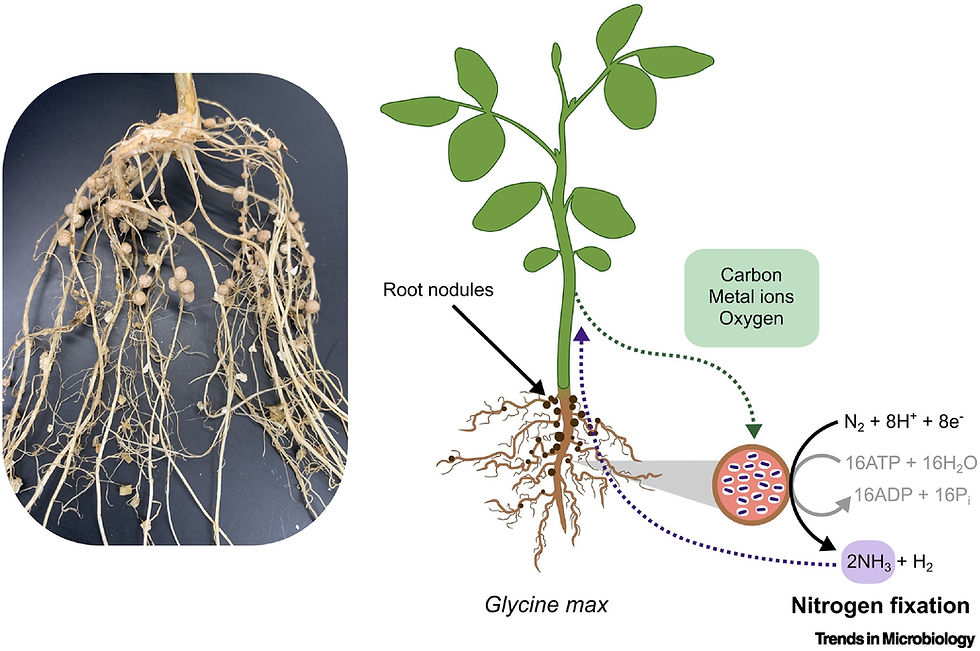
Diazotrophs—microorganisms capable of nitrogen fixation—use nitrogenase to convert atmospheric nitrogen gas into ammonia. Fixed nitrogen subsequently enters biological compounds. Its contribution to crop nutrition depends on the relationship between the microorganism and the plant. [5]
In a compatible legume–rhizobium symbiosis, nitrogen fixation occurs within root nodules. Outside such partnerships, nitrogen may remain in microbial biomass before becoming available through release or turnover. Detecting a nitrogen-fixing organism does not establish how much nitrogen it delivers to a crop. [4, 6]
A microorganism can also improve plant growth through mechanisms that do not add nitrogen. Selected plant growth-promoting rhizobacteria affect root architecture through interactions with plant signaling. A larger or differently branched root system may improve nutrient exploration, but a growth response alone does not prove nitrogen fixation. [5, 7]

For the biological process, read what nitrogen fixation is and how nitrogen fixation by bacteria works.
Which nitrogen-fixing bacteria should be considered?
Start with the organism’s relationship to the crop, then evaluate the strain and formulation.
Relationship | Examples or defining feature | Selection priority |
Symbiotic | Rhizobia, including Rhizobium and Bradyrhizobium, forming nodules on compatible legumes | Correct host–strain match and effective nodulation [5] |
Associative | Selected Azospirillum strains closely associated with roots, especially in grass and cereal research | Evidence for the intended crop; distinguish growth promotion from nitrogen delivery [5, 9] |
Free-living | Diazotrophs such as Azotobacter vinelandii functioning outside an obligatory nodule partnership | Conditions supporting activity and evidence of a useful crop contribution [6] |
Endophytic | Diazotrophs documented to colonize internal plant tissues | Demonstrated colonization and performance in the intended host [4] |
These relationships are useful descriptions rather than rigid compartments; some organisms occupy more than one niche. [6]

Compare these groups in our nitrogen-fixing bacteria overview.
Rhizobial strains should not be treated as interchangeable between soybean, peas, lentils, clover and other legumes. Likewise, a cereal result for one Azospirillum strain does not establish the performance of another strain or formulation. [5, 9]
For further reading, see the different types of nitrogen-fixing bacteria, our Azospirillum brasilense guide, and soil conditions relevant to Azotobacter vinelandii.
How beneficial microbes can contribute to a nitrogen program
1. Biological nitrogen fixation
Compatible nitrogen-fixing associations can contribute nitrogen to a crop or cropping system. The contribution depends on the organism, host, environment and management; it cannot be assigned from a species name alone. Legume-based systems have a substantial established role in agricultural nitrogen inputs. [4, 5]
2. Root development and nutrient acquisition
Selected beneficial bacteria can alter root branching, root hairs and other root traits. These responses create a plausible pathway to improved nutrient acquisition. Their value depends on whether they produce a measurable benefit in the relevant crop and field conditions. [7]
3. Organic nitrogen cycling
Soil microorganisms participate in decomposition and nutrient recycling. [13] However, more decomposition does not always mean more nitrogen immediately available to the crop: high-carbon residues can encourage temporary microbial immobilization. [3]
The useful outcome is nitrogen becoming available when roots can capture it. A general decomposer claim is therefore insufficient evidence for a specific fertilizer-reduction program.
4. Complementary nutrient functions
Nitrogen nutrition also interacts with the wider fertility program. A global biofertilizer meta-analysis found that response varied with factors including crop group, climate and soil phosphorus. Some combinations of nitrogen-fixing and phosphorus-solubilizing functions performed favorably in the analyzed research. That supports investigating complementary functions, rather than assuming that every blend will outperform its ingredients. [8]
What does research show about microbial inoculants and NUE?
Research supports the potential of microbial inoculants, while also showing why crop- and product-specific evaluation is essential.
Global evidence: useful potential, variable response
Schütz and colleagues’ 2018 meta-analysis drew on 171 eligible publications and reported improvements in yield and nutrient-use-efficiency measures across its database. Responses differed among crops, environments and inoculant groups. These pooled findings support further application and evaluation; they do not provide a universal nitrogen replacement percentage. [8]
Brazilian maize: evidence for specified Azospirillum strains
Barbosa and colleagues’ 2022 meta-analysis evaluated 103 maize field trials at 54 Brazilian locations, focusing on Azospirillum brasilense strains Ab-V5 and Ab-V6. It reported an average grain-yield increase of 5.4% with inoculation. [9]
This is evidence for those strains in the analyzed Brazilian systems. It is not a prediction for every Azospirillum product, and the yield response should not be converted into an equivalent quantity of fixed nitrogen.
Practical ways to improve nitrogen use efficiency
Microbial selection belongs within a sound crop nutrition program. The 4R approach—right source, rate, time and place—provides a useful starting point. [12]
Establish the nitrogen budget. Account for the intended yield and locally appropriate credits from soil supply, manure and previous crops. Identify the information needed before changing a rate.
Select source and placement together. Consider how the nitrogen source behaves in the soil and how placement affects root access and loss risk.
Match timing to demand. Use crop growth stage, field conditions and regional guidance to choose application timing.
Address physical limitations. Investigate drainage, compaction or other conditions restricting root activity; an inoculant should not be expected to correct every field constraint.
Choose a microbial function that fits the problem. Evaluate a host-compatible nitrogen fixer where nitrogen contribution is the objective, or documented nutrient-acquisition functions where uptake is the focus.
Test the proposed change. Evaluate yield, quality and economics before adopting a reduced-input program across the operation.
For crop-specific context, see our wheat fertilizer guide. For rotations, read how beneficial bacteria help legumes fix nitrogen and what the next crop receives.
Develop a nitrogen-fixing microbial program with IndoGulf BioAg
IndoGulf BioAg works with industry partners seeking bulk microbial supply and custom blends. Start with our nitrogen-fixing bacteria landing page to explore the functional groups and discuss organism selection.
For a commercial enquiry, share your company, target market, intended crops, application route, formulation requirements, development stage and anticipated purchase volumes. This helps our team assess technical suitability and the scope of a supply partnership.
Contact IndoGulf BioAg to discuss your program, or explore our private label services for a branded formulation project.
Frequently asked questions
What is nitrogen use efficiency in agriculture?
NUE evaluates useful production or nitrogen recovery relative to nitrogen supply. Always specify the metric: yield per unit of fertilizer, apparent crop recovery and system nitrogen balance answer different questions. [1, 2]
What is the nitrogen use efficiency formula?
For PFP, divide crop yield by fertilizer N applied. AE and apparent recovery use zero-N comparisons, as shown in the table above. [1]
What is a good nitrogen use efficiency value?
Interpret the metric with yield, quality, nitrogen inputs and soil stocks. A high system ratio can reflect nitrogen-stock depletion rather than a sustainable improvement. [2]
Can nitrogen-fixing bacteria reduce nitrogen fertilizer requirements?
They can contribute to nitrogen supply in suitable associations. Whether a specific inoculant supports a lower fertilizer rate must be established for the crop and conditions. Positive evidence and trials without consistent benefits both exist; no universal reduction follows from inoculation. [5, 9, 10]
Are all plant growth-promoting bacteria nitrogen-fixing bacteria?
No. Selected strains can promote growth through nutrient mobilization or interactions with root development without fixing nitrogen. Verify nitrogen-fixing capability separately from a general growth-promoting designation. [5]
Are nitrifying bacteria the same as nitrogen-fixing bacteria?
No. Nitrifying organisms transform ammonium into nitrite and nitrate. Nitrogen-fixing organisms convert atmospheric nitrogen into ammonia. Transformation of existing nitrogen and addition of new nitrogen are different functions. [5, 15]
Can a greener crop prove improved NUE?
Greener leaves can justify further assessment, but they do not establish an NUE value or the nitrogen source. Record nitrogen inputs and measure yield or nitrogen uptake using an appropriate comparison.
Can microbial inoculants be applied with fertilizers or pesticides?
Only where the specific formulation, application conditions and product instructions support the combination. For seed-applied products, assess survival through treatment and storage as well as germination. Do not assume universal compatibility. [14]
Scientific references
Congreves, K. A., Otchere, O., Ferland, D., Farzadfar, S., Williams, S., & Arcand, M. M. (2021). Nitrogen Use Efficiency Definitions of Today and Tomorrow. Frontiers in Plant Science, 12, 637108. https://doi.org/10.3389/fpls.2021.637108.
EU Nitrogen Expert Panel (2015). Nitrogen Use Efficiency (NUE): An Indicator for the Utilization of Nitrogen in Agriculture and Food Systems. Wageningen University, Alterra. Full report.
University of Minnesota Extension. Understanding nitrogen in soils. Official guidance.
Ladha, J. K., Peoples, M. B., Reddy, P. M., Biswas, J. C., Bennett, A., Jat, M. L., & Krupnik, T. J. (2022). Biological nitrogen fixation and prospects for ecological intensification in cereal-based cropping systems. Field Crops Research, 283, 108541. https://doi.org/10.1016/j.fcr.2022.108541. Accessible full text.
Ahemad, M., & Kibret, M. (2014). Mechanisms and applications of plant growth promoting rhizobacteria: Current perspective. Journal of King Saud University – Science, 26(1), 1–20. https://doi.org/10.1016/j.jksus.2013.05.001. Supplied advance-publication PDF dated 2013; final volume publication is 2014.
Smercina, D. N., Evans, S. E., Friesen, M. L., & Tiemann, L. K. (2019). To Fix or Not To Fix: Controls on Free-Living Nitrogen Fixation in the Rhizosphere. Applied and Environmental Microbiology, 85(6), e02546-18. https://doi.org/10.1128/AEM.02546-18. A later erratum corrects acknowledgments, not the scientific conclusions.
Vacheron, J., Desbrosses, G., Bouffaud, M.-L., Touraine, B., Moënne-Loccoz, Y., Muller, D., Legendre, L., Wisniewski-Dyé, F., & Prigent-Combaret, C. (2013). Plant growth-promoting rhizobacteria and root system functioning. Frontiers in Plant Science, 4, 356. https://doi.org/10.3389/fpls.2013.00356.
Schütz, L., Gattinger, A., Meier, M., Müller, A., Boller, T., Mäder, P., & Mathimaran, N. (2018). Improving Crop Yield and Nutrient Use Efficiency via Biofertilization—A Global Meta-analysis. Frontiers in Plant Science, 8, 2204. https://doi.org/10.3389/fpls.2017.02204.
Barbosa, J. Z., Roberto, L. A., Hungria, M., Corrêa, R. S., Magri, E., & Correia, T. D. (2022). Meta-analysis of maize responses to Azospirillum brasilense inoculation in Brazil: Benefits and lessons to improve inoculation efficiency. Applied Soil Ecology, 170, 104276. https://doi.org/10.1016/j.apsoil.2021.104276. Embrapa repository.
Paul, R. M., Singh, G., Nelson, K. A., & Kaur, G. (2026). Corn response to biological products and a nitrification inhibitor. Agrosystems, Geosciences & Environment, 9, e70383. https://doi.org/10.1002/agg2.70383.
Adesemoye, A. O., Torbert, H. A., & Kloepper, J. W. (2009). Plant Growth-Promoting Rhizobacteria Allow Reduced Application Rates of Chemical Fertilizers. Microbial Ecology, 58, 921–929. https://doi.org/10.1007/s00248-009-9531-y. USDA-hosted full text.
University of Minnesota Extension. Advanced Nitrogen Smart: A deep dive into the 4Rs. Official guidance.
Thepbandit, W., & Athinuwat, D. (2024). Rhizosphere Microorganisms Supply Availability of Soil Nutrients and Induce Plant Defense. Microorganisms, 12, 558. https://doi.org/10.3390/microorganisms12030558. Used here for nutrient-cycling context, not disease-control claims.
Rocha, I., Ma, Y., Souza-Alonso, P., Vosátka, M., Freitas, H., & Oliveira, R. S. (2019). Seed Coating: A Tool for Delivering Beneficial Microbes to Agricultural Crops. Frontiers in Plant Science, 10, 1357. https://doi.org/10.3389/fpls.2019.01357.
Kendzior, J., Warren Raffa, D., & Bogdanski, A. (2022). The soil microbiome: a game changer for food and agriculture — Executive summary for policymakers and researchers. Rome, FAO. https://doi.org/10.4060/cc0717en. Supplied report; used for nitrogen-cycle context.
Research on an organism or named strain does not establish the performance of every commercial formulation. Application rates and fertilizer changes should follow product-specific information, local agronomic guidance and appropriate validation.


Comments