What Are the Steps in the Denitrification Process?

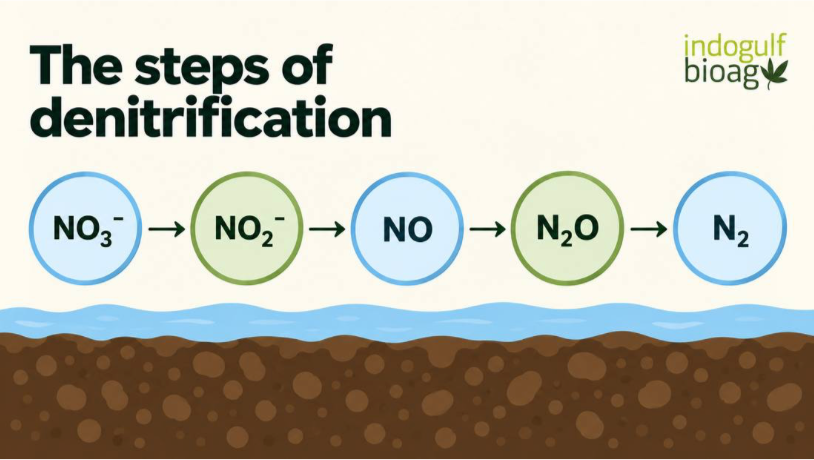
Denitrification changes nitrate into nitrogen gas through four sequential microbial reduction steps. The familiar shorthand is nitrate → nitrite → nitric oxide → nitrous oxide → nitrogen gas. Each arrow represents a distinct enzyme-driven reaction, not a single conceptual leap, and the pathway runs especially well in oxygen-poor settings where microorganisms use nitrate, rather than oxygen, to respire [1] [2].
This guide walks through each of the four steps, the enzyme responsible for it, and why the last step — not the first — is usually what decides whether denitrification was an environmental win or a climate liability.
Four Steps, Four Enzymes
The reduction of nitrate to nitrogen gas is carried out by four different types of metalloenzymes, one per step: nitrate reductase, nitrite reductase, nitric oxide reductase, and nitrous oxide reductase [1]. Each enzyme is a discrete piece of cellular machinery, and a given denitrifying organism may carry some, all, or none of the complete set — a detail that turns out to matter more than the overall reaction summary suggests.
Step 1: Nitrate Becomes Nitrite
A nitrate reductase enzyme converts nitrate (NO₃⁻) into nitrite (NO₂⁻). The nitrate feeding this first step can come from several places: soil nitrogen cycling (nitrification of ammonium), applied fertilizer, wastewater, or drainage water carrying dissolved nitrate from elsewhere [1] [2].
Nitrite is only an intermediate. Detecting that nitrate has declined in a soil or water sample does not, by itself, show that the full pathway has run — nitrite could accumulate, or the nitrate could have been consumed by an entirely different process (more on that below).
Step 2: Nitrite Becomes Nitric Oxide
A nitrite reductase enzyme converts nitrite into nitric oxide (NO), a small, highly reactive gas. Nitric oxide is not treated as a desired end product in its own right; it is typically processed further by the same microbial machinery almost as quickly as it forms [1].
Step 3: Nitric Oxide Becomes Nitrous Oxide
A nitric oxide reductase enzyme converts NO into nitrous oxide (N₂O). This step matters disproportionately, because nitrous oxide is stable enough to escape from soil or water before the fourth and final reaction has a chance to run. Nitrous oxide is itself a long-lived greenhouse gas, so measuring only how much nitrate disappeared does not capture the full environmental outcome of a denitrification event — a gram of nitrogen that leaves as N₂O is a very different result from a gram that leaves as inert N₂ [1] [3].
Step 4: Nitrous Oxide Becomes Nitrogen Gas
A nitrous oxide reductase enzyme converts N₂O into nitrogen gas (N₂). Nitrogen gas makes up roughly 78% of the atmosphere already and is the typical, intended end product of complete denitrification. In nitrate-laden, oxygen-poor water or soil, producing N₂ is a genuine form of nitrogen removal, with none of the climate cost that an incomplete pathway carries [1] [2].
This fourth enzyme, nitrous oxide reductase, is also the one most sensitive to disruption from soil acidity and other stresses, which is precisely why it deserves closer attention than the other three.
Why a Pathway May Stop Early
Not every microorganism carries the full four-enzyme set, and environmental conditions can slow one reaction more than another, so intermediates can accumulate rather than continuing on to nitrogen gas. Oxygen, available carbon, nitrate supply, moisture, and pH all influence which reaction in the sequence becomes the bottleneck [2].
Acidic soil conditions are a particular concern for the final step. Denitrifying bacteria tested in laboratory studies show a product ratio — the proportion of nitrogen released as N₂O rather than N₂ — that correlates with acidity, apparently because low pH interferes with the correct assembly of the nitrous oxide reductase enzyme itself, not merely its activity level [4]. The same pattern held when whole soils and soil-extracted microbial communities were tested, not just isolated laboratory strains [4]. Liming acidic soil is one proposed way to reduce the share of nitrogen lost as nitrous oxide, though that specific management outcome still needs field-level verification rather than being assumed from laboratory and soil-extract results alone [4].
The picture has a genuine exception worth naming, because it shows how much strain-level and community-level variation matters here: in one aquifer study, a community enriched in a specific type of nitrous oxide reductase gene (so-called Clade II) was found actively reducing nitrous oxide at a pH of 4 — below the pH of roughly 5 usually treated as the practical limit for that final reaction [5]. The general rule (acidity impairs the last step) holds broadly, but which specific organisms and enzyme variants are present can shift where that boundary actually sits on a given site.
Not Every Organism Carries the Full Toolkit
The nitrous oxide reductase enzyme itself comes in at least two distinct evolutionary lineages, referred to as clade I and clade II, which differ in their genetic organization, their sensitivity to oxygen and nitrate, and the ecological niches where they are typically found [6]. Some organisms that carry a complete denitrification gene set nonetheless behave differently from organisms that carry only nitrous oxide reductase without the earlier three enzymes — the latter can consume nitrous oxide produced by other organisms nearby without ever having produced any of their own [6].
This is a genuinely active area of research, and it matters practically: which clade of nitrous oxide reductase dominates a given soil or bioreactor community has been linked directly to how much nitrous oxide that system yields overall, for instance in the carbon-limited, oxygen-fluctuating conditions found inside a woodchip bioreactor used to treat agricultural drainage water [7].
Nitrate Disappearance Is Not Proof of Complete Denitrification
Denitrification is not the only pathway competing for nitrate once oxygen becomes limiting. Dissimilatory nitrate reduction to ammonium (DNRA) reduces nitrate to ammonium instead of to gas, retaining rather than removing the nitrogen, and anaerobic ammonium oxidation (anammox) offers yet another route to nitrogen gas that does not pass through the four-enzyme denitrification sequence at all [2]. A global synthesis found denitrification responsible for up to 66.1% of total nitrate reduction across ecosystems, with DNRA accounting for about 21.2% and anammox about 12.7% — meaningful shares, not rounding errors [8].
The practical consequence: observing that nitrate levels have fallen in a soil or water sample tells you nitrate was consumed. It does not, by itself, tell you which of these pathways did the consuming, nor whether the denitrification pathway — if it was responsible — ran all four steps to completion.
What the Evidence Does Not Support
That nitrate disappearance alone proves denitrification occurred, let alone that it completed all four steps [2] [8]
That every denitrifying organism carries the complete four-enzyme pathway; many do not [6]
That acidic soil always maximizes nitrous oxide loss regardless of which microbial community is present; enrichment in specific nitrous oxide reductase variants has been shown to sustain reduction activity even at low pH in at least one documented case [5]
That a fixed, universal proportion of denitrified nitrogen escapes as nitrous oxide versus nitrogen gas across all soils and systems; the ratio depends on the specific organisms, pH, oxygen, and carbon conditions present [2] [4]
Best Conditions for Completing All Four Steps
Sufficient time in oxygen-poor conditions for the full enzyme sequence to run, rather than a brief anoxic pulse
Soil or water pH close to neutral, which the laboratory and soil-community evidence associates with more complete conversion to nitrogen gas rather than nitrous oxide [4]
A microbial community that includes organisms carrying a full, functional nitrous oxide reductase, not only the earlier three enzymes
An adequate, accessible carbon or other electron-donor supply so the final reduction step is not starved partway through [7]
Recognition that even favorable conditions do not guarantee complete conversion; product ratios vary by community composition in ways that are not always predictable from bulk soil chemistry alone [4]
Practical Tips for Reading Denitrification on Your Own Ground
Do not equate a drop in soil nitrate with confirmed, complete denitrification; consider DNRA and anammox as alternative explanations, particularly in nitrogen-rich or waterlogged soils [8]
Where soils are acidic and saturated, treat nitrous oxide loss, not just nitrate loss, as a real possibility worth managing
Consider liming acidic, poorly drained fields as a long-term step toward more complete conversion to nitrogen gas, while recognizing this still needs field verification on your own soils [4]
If you operate or specify a woodchip bioreactor or constructed wetland for nitrate treatment, monitor nitrous oxide as well as nitrate removal — a system can look effective on nitrate alone while still releasing meaningful nitrous oxide [7]
Keep expectations for "denitrification" specific: name which step or outcome you actually mean — nitrate removal, complete conversion to N₂, or partial conversion with N₂O loss — since these carry very different implications
FAQs
What is the order of the four denitrification steps?
Nitrate (NO₃⁻) → nitrite (NO₂⁻) → nitric oxide (NO) → nitrous oxide (N₂O) → nitrogen gas (N₂), each step catalyzed by a different enzyme [1].
Does every denitrifying microorganism have all four enzymes?
No. Some organisms carry the complete set; others carry only some of the enzymes, including some that only reduce nitrous oxide without producing any of their own [6].
Why does acidic soil increase nitrous oxide emissions?
Laboratory and soil-community evidence links soil acidity to interference with the assembly of the nitrous oxide reductase enzyme, which raises the proportion of nitrogen released as N₂O rather than N₂ [4].
Is nitrous oxide reduction always blocked in acidic soil?
Not always. At least one aquifer study found a nitrous oxide reductase-enriched community actively reducing N₂O at a pH of 4, below the pH of roughly 5 usually treated as a practical limit — a reminder that community composition, not just pH, governs the outcome [5].
Can nitrate disappear from soil without denitrification happening at all?
Yes. Dissimilatory nitrate reduction to ammonium (DNRA) and anaerobic ammonium oxidation (anammox) are separate microbial pathways that also consume nitrate, and together they can account for roughly a third of total nitrate reduction globally [8].
Does liming acidic soil reduce nitrous oxide emissions from denitrification?
It is a plausible, evidence-supported hypothesis based on laboratory and soil-extract studies, but the specific field-scale outcome still needs verification through field experiments before it can be treated as an established management result [4].
Remember the sequence as NO₃⁻ → NO₂⁻ → NO → N₂O → N₂. The final arrow is what separates complete conversion to harmless nitrogen gas from the potential release of a potent greenhouse gas, and which organisms are present — as much as which conditions prevail — decides how far along that sequence a given system actually gets.
Published evidence on the denitrification pathway describes general enzymatic mechanisms; how far the pathway runs on any given site depends on the specific microbial community, soil or water chemistry, and management, and should be assessed for that site rather than assumed from the general sequence.
Build Stronger Biological Programs with IndoGulf BioAg
Understanding how far a nitrogen-transforming pathway actually runs — not just what it is capable of in principle — is central to building a nutrient program you can trust.
IndoGulf BioAg develops and supplies non-GMO nitrogen-fixing bacterial cultures and biofertilizer formulations designed to supply nitrogen through biological processes as part of an integrated nutrient-management program, for agriculture, horticulture, seed treatment, and private-label applications. Strain identity, viable-cell concentration, formulation options, and quality-control specifications are available on request. Contact our team to discuss a nitrogen strategy suited to your soils and cropping system.

References
1. Tavares P, Pereira AS, Moura JJG, Moura I. Metalloenzymes of the denitrification pathway. Journal of Inorganic Biochemistry, 2006;100(12):2087-2100. DOI: 10.1016/j.jinorgbio.2006.09.003
2. Giles M, Morley N, Baggs EM, Daniell TJ. Soil nitrate reducing processes — drivers, mechanisms for spatial variation, and significance for nitrous oxide production. Frontiers in Microbiology, 2012;3:407. DOI: 10.3389/fmicb.2012.00407 — free full text
3. U.S. Environmental Protection Agency. Understanding Global Warming Potentials, nitrous oxide section. epa.gov
4. Bakken LR, Bergaust L, Liu B, Frostegård Å. Regulation of denitrification at the cellular level: a clue to the understanding of N₂O emissions from soils. Philosophical Transactions of the Royal Society B, 2012;367(1593):1226-1234. DOI: 10.1098/rstb.2011.0321 — free full text
5. Hunt KA, Carr AV, Otwell AE, et al. Contribution of microorganisms with the clade II nitrous oxide reductase to suppression of surface emissions of nitrous oxide. Environmental Science & Technology, 2024;58(16):7056-7065. DOI: 10.1021/acs.est.3c07972
6. Moir JWB, Toet S, Keane B. Nitrous oxide flux: what microbial physiology can do to mitigate climate change gas production. Advances in Microbial Physiology, 2025;87:119-161. DOI: 10.1016/bs.ampbs.2025.04.001
7. McGuire PM, Butkevich N, Saksena AV, Walter MT, Shapleigh JP, Reid MC. Oxic-anoxic cycling promotes coupling between complex carbon metabolism and denitrification in woodchip bioreactors. Environmental Microbiology, 2023;25(9):1696-1712. DOI: 10.1111/1462-2920.16387
8. Deng D, He G, Ding B, Liu W, Yang Z, Ma L. Denitrification dominates dissimilatory nitrate reduction across global natural ecosystems. Global Change Biology, 2024;30(3):e17256. DOI: 10.1111/gcb.17256
Peer-reviewed sources were located via PubMed and publisher records; free full-text links point to PubMed Central where an open-access version is available. The EPA institutional source URL was provided in the original project brief; live links should be spot-checked before publication per house citation rule §4.


Comments